Swiss International Gemlab Launches, Providing AI-Assisted Gemstone Services
The Trade in FocusThere’s a new gem lab to serve the industry, offering AI-supported colored gemstone services to offer faster results and greater transparency to the trade, it has said.
Three gemologists and longtime industry members founded Swiss International Gemlab (SIG). Willy Bieri, SIG’s chief science officer, joined with more than 20 years of expertise in gemstone microscopy and advanced analytical methods. Lawrence Hahn, chief operating officer, has more than 15 years of gemological expertise combined with nine years of commercial and operational gem trade leadership. And Matthias Alessandri, the chief technology officer of SIG, brought over 14 years of gem lab experience, complemented by a background in banking and information technology.
What makes it different from other labs serving the industry is that all three of the founders “are simultaneously the senior gemologists operating the lab,” its founders told GemGuide.
“Each founder brings 15-20 years of hands-on experience having run labs from Europe to the USA to Asia. Beyond having each inspected well over a hundred thousand stones, we’re using the opportunity of starting a new laboratory to combine our deep lab experience with modern spectroscopy to deliver reliable results. These results are structured with a clear, simple-to-understand nomenclature, presented on a straightforward report layout. On the customer experience side, we take a transparent approach with the public and our clients, aiming for a frictionless, customer-oriented experience.”
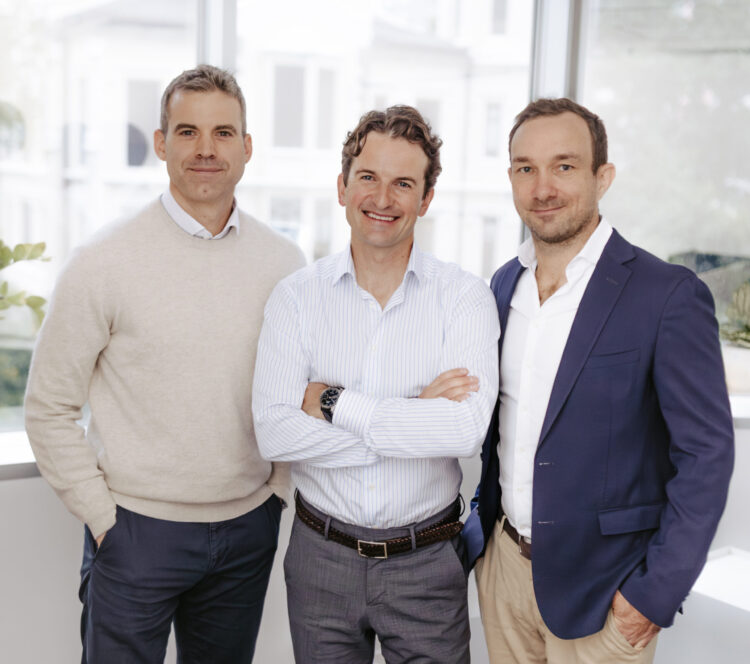
The Swiss International Gemlab founders, from left to right: Matthias Alessandri, Willy Bieri, and Lawrence Hahn.
Their goal? To be among the top three internationally accepted gemstone labs within five years, “prioritizing quality and strict ethics over quantity.”
SIG offers gem identification, origin determination, treatment analysis, color grading, and review and interpretation from experts on a report. It performs these for all major colored stone varieties.
The lab employs a proprietary AI system, called SIG-AI Assistance, to assist its gemologists in grading and consistency in services. This includes origin determination, which the trade knows to be expert opinions based on experience and data collected from gemstones of known origin. When asked about addressing potential concerns from industry members about AI use in the space, the founders acknowledged that origin determination isn’t always straightforward.
“The use of AI and machine learning technology doesn’t solve this problem on its own; experience, and having seen thousands of stones from different origins, is what helps. At SIG, we don’t see AI as a replacement for the gemologist, but as a scientific amplifier: it lets us build tools faster for data analysis and workflow optimization.
“Our vision is a laboratory where decades of expertise work alongside state-of-the-art data analysis, producing results that are more precise, faster, and more reproducible. Anyone building a lab today for the next 20 years has to consider AI from the outset, just as no one would plan a lab today without digital infrastructure. Having had no exposure to AI in our earlier work, this is an exciting greenfield project for us, given both its novelty and the pace at which the technology is advancing.”
For origin determination services, SIG said it has a “solid” reference collection built for rubies, sapphires, and emeralds as well as other commercially important gem species. Its founders said they are still actively building on it, collecting samples from mines and acquiring them on the market.
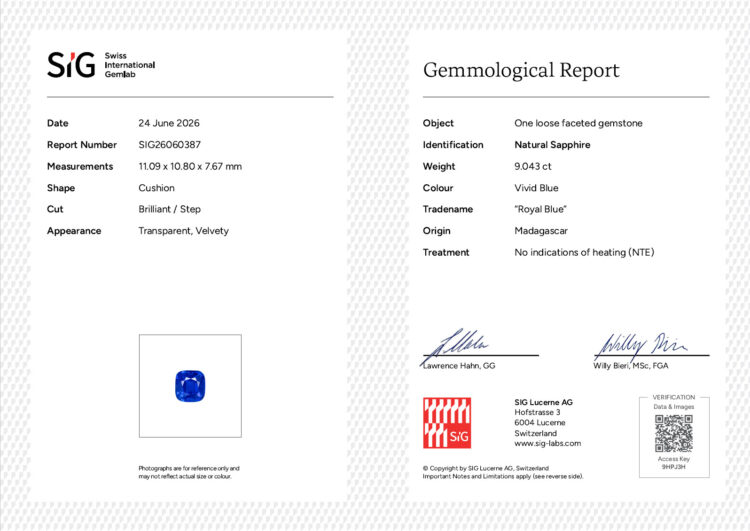
A sample report from SIG.
For color grading, the lab has built harmonized color master sets for rubies, sapphires, emeralds, and stones like tourmalines (including cuprian), among others. The team sourced color samples from the market and worked through them together to create multiple sets per color/species that are harmonized with one another so each lab “speaks the same language.” They also use a harmonized light box, developed in-house, with matching output values and a high CRI across every location, allowing colors to be rendered true to life. “Color grading remains a constant challenge, since every colored gemstone is unique and some subjectivity is unavoidable. Our harmonized, standardized approach keeps that to a minimum,” SIG’s founders said.
The lab uses trade names such as royal blue and pigeon’s blood on reports since they have become established in the market, the founders said, but they noted that they work strictly from their master sets to keep the range consistent. For copper-bearing tourmalines, for example, they specify the type under “identification,”—cuprian elbaite tourmaline or cuprian liddicoatite tourmaline. For colors ranging from blue to green and those in between, SIG applies the trade name “Paraíba color” or “Paraíba neon color” depending on saturation level. Then in the note section of the report, a note is added that says, “This copper-bearing tourmaline may be referred to as ‘Paraíba tourmaline.’”
SIG is now operational in Lucerne, Switzerland, and Hong Kong. In addition to officially launching at the GemGenève show in May, the lab also exhibited and tested at the Hong Kong June show. They will be present at the Hong Kong September show, at AsiaWorld-Expo. SIG also accepts shipments at both locations and can accommodate most shipping methods. Detailed shipping instructions will be online this coming week, the team said.
They are currently evaluating expansions into other locations, but in the meantime are focused on serving their growing customer base through the Switzerland and Hong Kong operations.