Gem Focus – August 2025 – Featuring Fire Agate: the chalcedony with a flaming iridescence
*Gem Focus & Market Pulse (Free Subscriber)Fire agate is a variety of chalcedony, a microcrystalline—which means its crystals are so small they can only be seen through a microscope—quartz, with inclusions of goethite or limonite that produce an iridescence.
Fire agates feature a robust display of colors, the more common among them brown, orange, and red, said to resemble a fire’s glowing embers. They can also have swirls of green, purple, and blue. Fine specimens exhibit multiple colors, with blue and purple being the most prized. These iridescent colors are caused by interference between light rays as they reflect and refract from the gem’s layers.
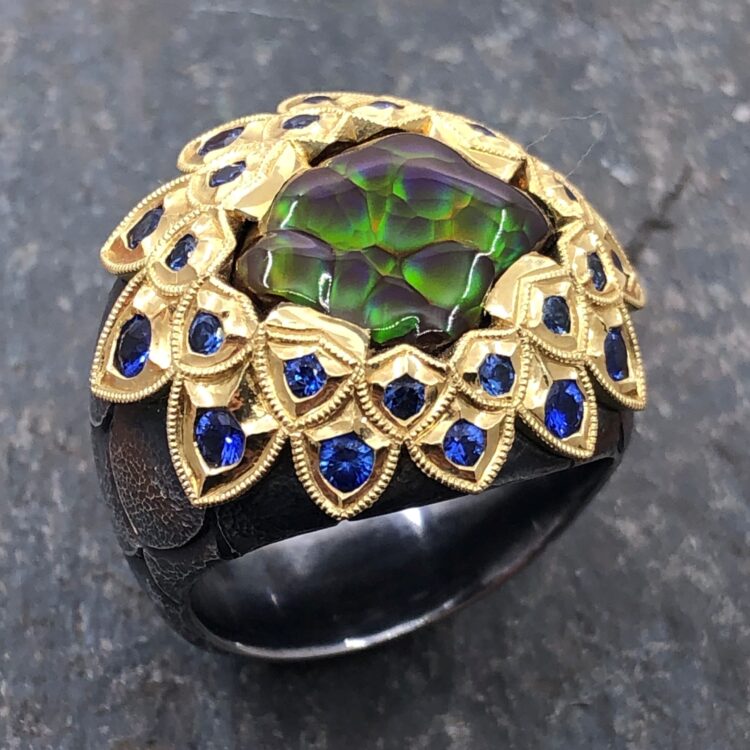
A fire agate and blue sapphire ring in 18-karat gold and oxidized sterling silver
from Jacob Raymond Jewelry.
Fire agate has been found in several locations in the U.S.—New Mexico, California, and Arizona—and Mexico, with the latter two being the most significant in terms of production.
According to GIA, fire agate formed millions of years ago, during the Tertiary Period. Volcanic activity led to hot water containing silica and iron oxide to fill cracks and voids in the surrounding host rock. It forms in botryoidal structure, resembling a cluster of grapes.
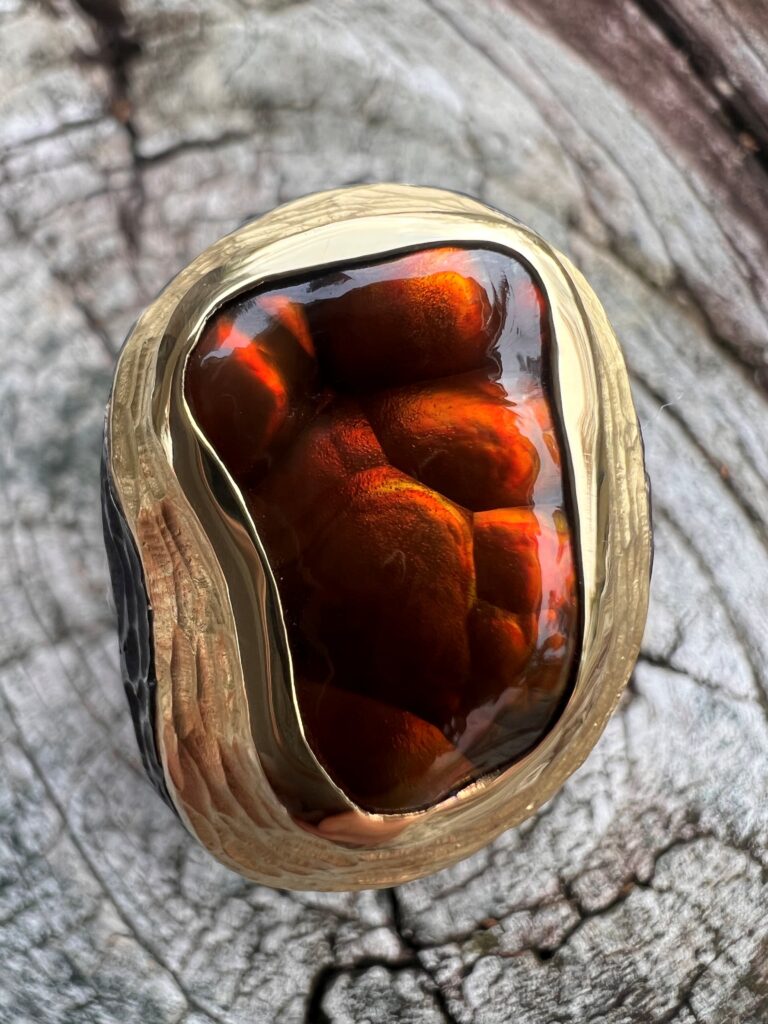
A fire agate, 18-karat gold, and oxidized sterling silver ring from Jacob Raymond Jewelry.
Fire agate is a relative newcomer to the world of use for personal adornment, having been known since the 1940s, and is finding a place in finished jewelry by designers looking for something unique. Because of the way it is found in nature, the material does not lend itself to faceting. Instead, it is seen in freeform shapes to preserve more of the gem, lending itself best to custom jewelry. Freeing the perfect iridescence from the stone requires expertise from a lapidary.
Fire agate is a 6.5-7 on the Mohs scale, durable, and takes a good polish.