Gem Focus – December 2024 – Featuring Apatite: the vibrant gem popular with connoisseurs
*Gem Focus & Market Pulse (Free Subscriber)Apatite is a phosphate mineral, transparent to translucent, most commonly seen in green to blue but can also be yellow, pink, violet/purple, and colorless. Transparent stones with good color can be faceted into gemstones, but because apatite is a 5 on the Mohs scale, it isn’t often used in jewelry, though it does appear here and there in necklaces and earrings, and is popular as a collectors’ stone.
The vibrant blues, comparable to Paraíba tourmaline, and those with a neon blue-green color command the highest prices and are most often what is seen in the jewelry world. (The vivid blues are often the result of heat treatment of green stones to enhance color.) The rich violet/purple material is also highly prized.
Apatite also has another feature popular with gem connoisseurs and collectors: fluorescence. According to the International Gem Society, yellow apatite fluoresces lilac-pink in short-wave long-wave UV light (stronger in long-wave); blue fluoresces violet-blue to sky blue; the violet material fluoresces greenish-yellow under long-wave or pale mauve under short-wave; and the greens fluoresce a greenish mustard color under both.
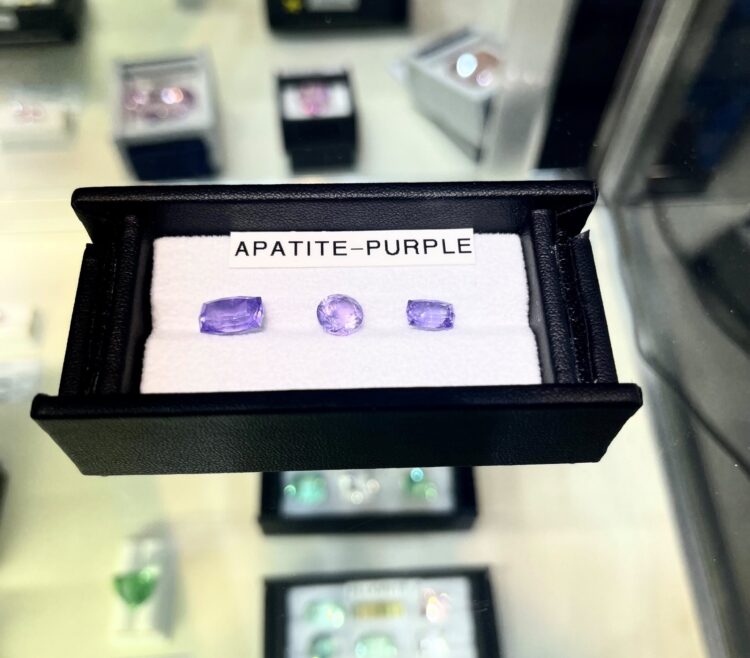
Purple apatite, sourced from Namibia, seen at the Coast to Coast Rare Gems booth
at the GJX gem show in Tucson in 2024.
(Photo credit: Gemworld International)
Cut stones in the blue material are likely to be smaller, in the 1- to 2-carat size range, but the yellow material from Mexico can be found more easily in larger sizes, even up to 15 to 20 carats. The rarest and smallest, in general, is the violet material.
Sources of gem-quality apatite includes Brazil, Burma, Mexico, Madagascar, Sri Lanka, Tanzania, Kenya, and India, among others.
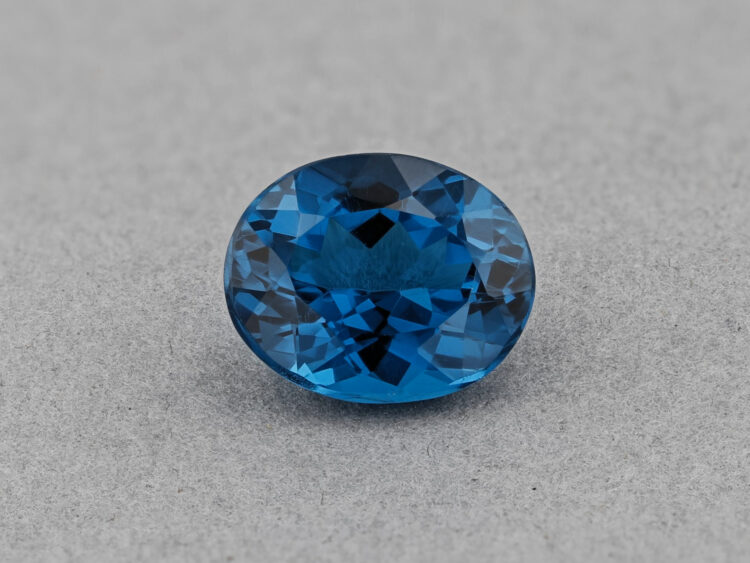
This 4.25-carat blue apatite from Minas Gerais, Brazil, is currently in the collection
at the Smithsonian’s National Museum of Natural History.
The popular blue material is similar in appearance to other gem materials like zircon, tourmaline, and topaz, and also has characteristics similar to some of those, especially its refractive index, making separation a little more difficult, but there are a few factors to pay attention to that can help. Hardness can separate apatite from tourmaline and topaz, which are a 7-7.5 and 8, respectively, on the Mohs scale. The spectroscope is also a good tool to separate apatite from tourmaline and topaz. Meanwhile, as a gem with strong double refraction, zircon’s RI—1.93 to 1.987—can separate it from apatite. Additionally, the specific gravity of apatite is 3.16-3.22, with an average of 3.19, while the specific gravity of zircon is between 3.90 and 4.73.
Because it is soft and brittle, apatite requires a lot of care, and jewelry professionals will know that ultrasonic cleaners should be avoided.